Jump to content
View in the app

A better way to browse. Learn more.

Tuts 4 You

A full-screen app on your home screen with push notifications, badges and more.

To install this app on iOS and iPadOS
  1. Tap the Share icon in Safari
  2. Scroll the menu and tap Add to Home Screen.
  3. Tap Add in the top-right corner.
To install this app on Android
  1. Tap the 3-dot menu (⋮) in the top-right corner of the browser.
  2. Tap Add to Home screen or Install app.
  3. Confirm by tapping Install.

Leaderboard

Popular Content

Showing content with the highest reputation since 01/01/2026 in File Comments

  1. m!x0r
    Some times to make patch to DLL file with our tool you need to understand when dll target get unpacked firstly this is the most important, and for that you need to understand the best moment of pointer position in main exe while debugging, our Loader able to detect Static Opcode in Static Stack, if you use this way you can Creat a Strong Loader for your Target EXE or DLL.
  2. m!x0r
    Here is an Example: DLL Protected By: ASProtect v2.x Static Opcode in Static Stack: Result: Test Files With ATPL Project & Loader: https://mega.nz/file/HZwxhA7J#aTuTBmfXkWbuGiMWaBhPTJpOfcoJsIB9jGDBkycilww Greetings AT4RE
  3. m!x0r
    Firstly you must Set Hardware Breakpoints on your Target address (where you want to make changes) Then You Must Break on System DLL Entry (For Identify the last Loaded DLL Befor The Pointer Stop on your Target address Finaly Set Memory Breakpoint on Write at .data Section of your main EXE Here we Go Like Last Example: Our DLL Befor Stop at our address is: wsock32.dll Next Step Finding Static Opcode in Static Stack and check our Code if Unpacked In DLL I hope This Tuto Can Help Greetings AT4RE
  4. decode
    Master, thank you very much for your interest; we are learning valuable information. However, for a DLL protected by VMP or Themida, how can we detect the point shown in the image via x32dbg? Where should we place the bp, or is there a simpler way? Professor, thank you very much for your interest; we are learning valuable information. However, for a DLL protected by VMP or Themida, how can we detect the point shown in the image via x32dbg? Where should we place the bp, or is there a simpler way?
  5. decode
    Unfortunately, it didn't work for me. Would you like me to send you an example exe, DLL, and patch addresses?
  6. bb2018
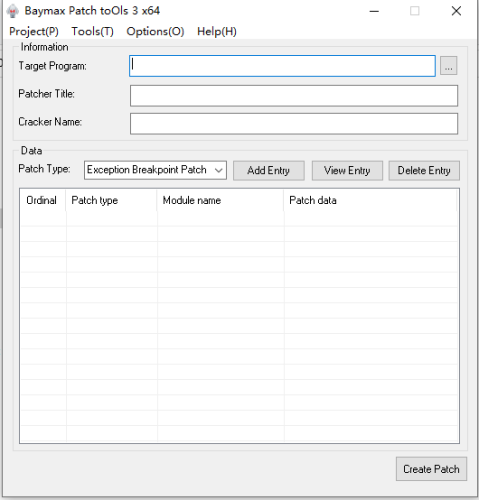
    2025.10.15 — x86/x64 v3.5.1.3 1.Patch customization: added a batch of hijack DLLs and you can configure hijack modules on the "Custom Patch Settings" page. Patches can now bundle custom files — non-PE files will be extracted to the target directory together with the patch, while other files can be optionally extracted. Patch data in the cracking modules PYG/PYG64 now supports dynamic expansion. 2.Added a small utility: “Process Hijack DLL Detector” — provides a closed loop from detecting usable hijack DLLs → generating a hijack DLL project → adding that custom hijack module into a patch. 3.The hijack code generator is now compatible with the latest VS2022; fixed intermediate directory settings. 4.When the patch logo popup is closed, the target application's main window is brought to the foreground. 5.The main program now generates a dump file when it crashes. 6.Fixed compatibility issues with VMP 3.x and several bugs — thanks to csjwaman and 真小白 for their bug reports. 7.Added tooltip (tip bubble) support on UI controls so full text can be displayed. 8.Thanks to KuNgBiM and 红豆 for providing multilingual files and proofreading copy. 9.Improved data protection, compatibility, and anti-debugging; thanks to kxoe for the suggestions. 10.Minor UX/details optimizations in the main program — for example, improved prompts when saving bpt projects. Baymax Patch Tools v3.5.1.3.zip Baymax Patch Tools x64 v3.5.1.3.zip Baymax toOls for x64dbg v1.9.5 1. Add replacement function for search data 2. Add feature code option with real-time effect 3. Add more language files Baymax toOls for x64dbg v1.9.5.zip

Account

Navigation

Search

Configure browser push notifications

Chrome (Android)
  1. Tap the lock icon next to the address bar.
  2. Tap Permissions → Notifications.
  3. Adjust your preference.
Chrome (Desktop)
  1. Click the padlock icon in the address bar.
  2. Select Site settings.
  3. Find Notifications and adjust your preference.