

-Analysis_Length_4219_ScanTime-_Milliseco.png.9b68973f4ab29db082e64e9264822f85.png)
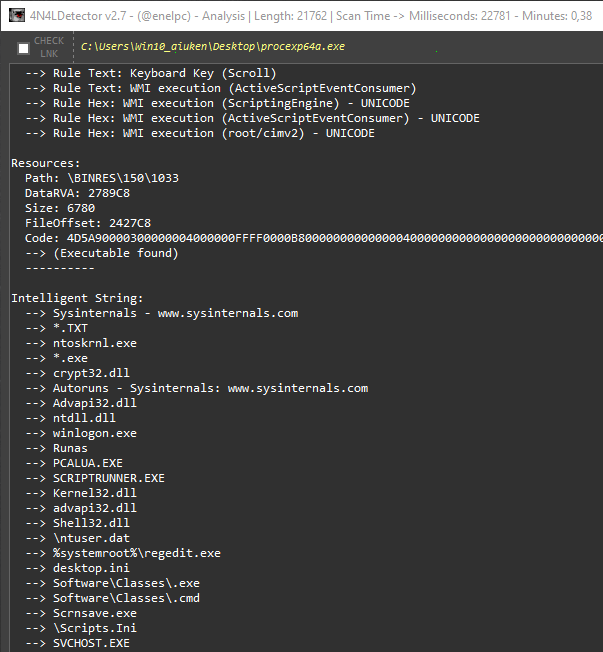
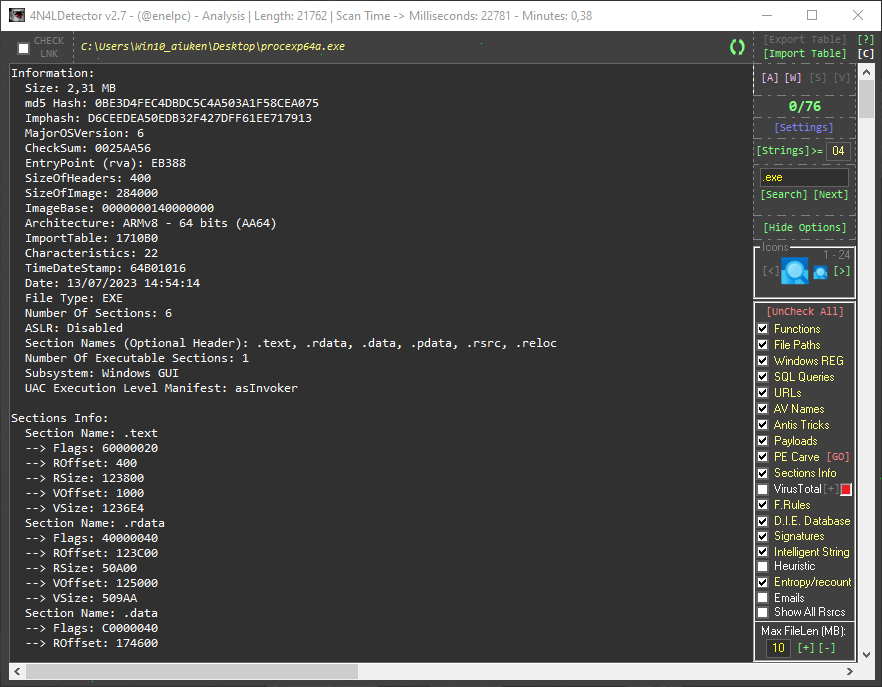
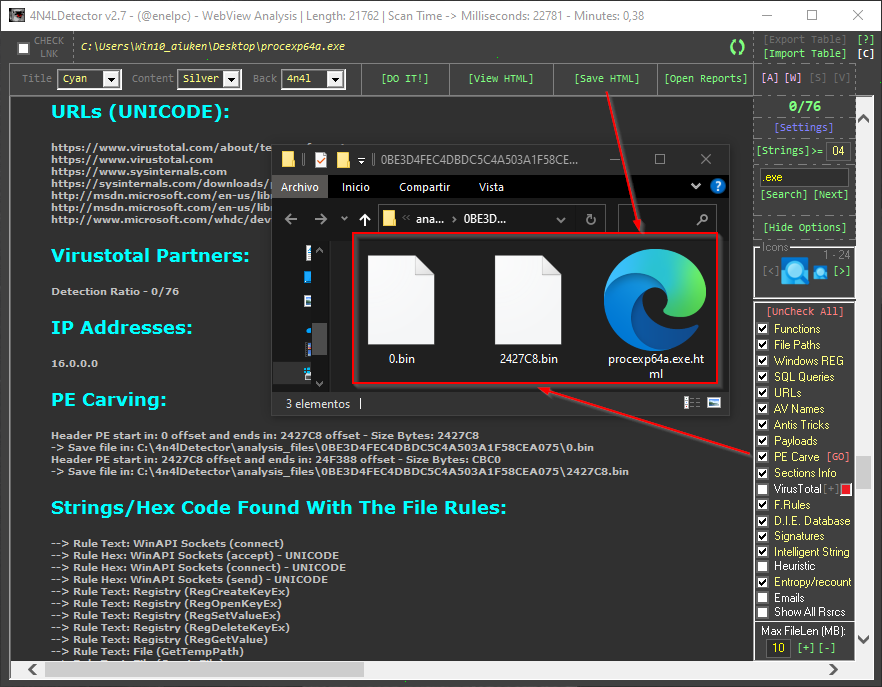
This is a scan tool for Microsoft Windows executables, libraries, drivers and mdumps. Its main objective is to collect the necessary information to facilitate the identification of malicious code within the analyzed files. This tool analyzes, among other things, the PE header and its structure, the content of the sections, the different types of strings, among many other things. It also incorporates a multitude of its own ideas to recognize anomalies in the construction of files and the detection of mechanisms used by current malware.
Using the tool is simple, just configure the options in the drop-down panel on the right and drag the samples into 4n4lDetector.
Full support:
- 32 bits (8086, x86, ARMv7)
- 64 bits (AMD64, x86-64, x64, ARMv8)
TI and ET Extraction:
Alpha AXP, ARM, ARM Thumb-2 (32-bit Thumb), ARM64, EFI Byte Code, EFI Byte Code (EBC), Hitachi SH3, Hitachi SH3, Hitachi SH4, Hitachi SH5, Intel i860, Intel Itanium (IA-64), M32R, MIPS16, MIPS16 with FPU, MIPS R3000, MIPS R4000, MIPS with FPU, MIPS little-endian, MIPS little-endian WCE v2, x64, x86, x86-64.
Buttons code:
- Buttons colored green are action buttons that open files and folders or are used to interact with the tool's utilities.
- The buttons colored in red perform reconfigurations, deletion of data or reset of functional files.
- Purple buttons announce the activation of online interactions.
- The pink buttons are shortcut buttons that the tool uses as tabs to navigate between different types of utilities.
Shortcuts:
- [A] Main analysis tab
- [W] Analysis tab in modifiable HTML format for report (WebView)
- [S] Viewer of strings extracted from the parsed file
- [V] Module with the Virustotal report using its API
Detections:
- PE Information
- Unusual Entry Point Position or Code (Algorithms, Anomalous Instructions... )
- Packers
- Compilations
- Binders/Joiners/Crypters
- Architectures
- Possible malicious functions
- Registry Keys
- Files Access
- Juicy Words
- Anti-VM/Sandbox/Debug
- URLs Extractor
- Payloads
- AV Services
- Duplicate Sections
- IP/Domains List
- Config RAT (Only In Memory Dumps)
- Call API By Name
- Unusual Chars In Description File (Polymorphic Patterns)
- Rich Signature Analyzer
- CheckSum Integrity Problem
- PE Integrity Check
- SQL Queries
- Emails
- Malicious resources
- PE Carve
- Exploits
- File Rules for Entry Points and more... 😃
Console Options (Analysis to file):
- 4n4lDetector.exe Path\App.exe -GUI (Start the graphical interface parsing a file from the console)
- 4n4lDetector.exe Path\App.exe -GREMOVE (Remove binary after scan)
- 4n4lDetector.exe Path\App.exe -TXT (Parse a file from the console and the output is written to a TXT file)
- 4n4lDetector.exe Path\App.exe -HTML (Parse a file from the console and the output is written to HTML file)
Edited by 4n0nym0us
What's New in Version 3.6.0
Released
4n4lDetector v3.6 is here, bringing greater stability, optimization, and security for analysts. As always, focused on defending creativity and delivering value through unique capabilities for Windows PE malware static analysis. Enjoy 🤓
v3.6
[+] The PE Carve module received memory optimizations and fixed a file truncation bug.
[+] Fixed an intermittent issue where Exception Table information might not be displayed.
[+] Fixed an intermittent issue that could affect the VirusTotal report generation process.
[+] Applied security checks and optimizations related to iteration, size validation, and memory management.
[+] Entry Point and Disassembler instructions now calculate addresses using the corresponding RVA and ImageBase across all architectures.
[+] Fixed an issue where instructions located in the last bytes of a file might not be disassembled from the visual view.
[+] Added a new feature that allows Highlights to be completely hidden by right-clicking on their information panel.
[+] Implemented VA calculation in Flow Anomalies detections for more accurate execution target representation.
[+] Added new Highlight detection labels based on the latest analysis features.
[+] Restructured the TLS Callbacks and Exceptions module descriptions to improve information clarity.
[+] Reworked suspicious API detection.
.... [-] APIs have been removed from the rules file.
.... [-] Existing APIs were integrated into the application's internal database along with their descriptions.
.... [-] Added new suspicious APIs to be highlighted in the main report.
[+] New Entry Point Flow Analysis (EP Flow Analysis) module.
.... [-] Detection of NOP sleds and padding instructions at the Entry Point.
.... [-] Identification of JMP SHORT and JMP NEAR redirections.
.... [-] Automatic tracking of jump chains and execution trampolines.
.... [-] Detection of invalid destinations or targets outside the PE image.
.... [-] Identification of possible Original Entry Point (OEP) relocations.
.... [-] Detection of backward redirections to code located before the Entry Point.
.... [-] Pre-Jump Analysis of instructions executed before the first redirection.
.... [-] Heuristic scoring system for classification of suspicious redirections.
-
 4
4
-
 3
3
Recommended Comments
Create an account or sign in to comment